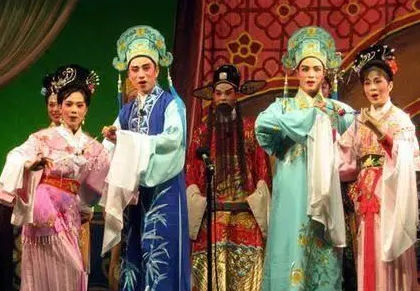
Zhengzi Opera
Introduction
Zhengzi Opera, also known as Zhengyin Opera, is an ancient and rare Chinese opera genre. It originated from Nanxi (Southern Drama). Rooted in the Hailufeng region, it is notable for its use of Zhongzhou Mandarin for singing and recitation, marking its linguistic uniqueness. It was included in the list of China's national-level intangible cultural heritage in 2006.
History
Emerging from Nanxi traditions, Zhengzi Opera preserved many classical elements of early Chinese drama. By the Ming Dynasty, it had solidified its style and repertoire. The opera thrived in the Hailufeng region, adapting to local cultural influences while maintaining its foundational traits. Its dissemination to nearby regions and overseas communities reflects its historical significance and cultural adaptability.
Repertoire
Zhengzi Opera boasts a rich repertoire of over 2,600 traditional plays, categorized into wenxi (civil plays) and wuxi (martial plays):
Civil plays emphasize lyrical narratives and emotional depth, exemplified by the "Four Great Joyful Plays" (Three Yuan Record, Five Gui Record, A Full Court of Officials, Moonlight Romance) and "Four Great Tragic Plays" (Hairpin Record, Sunflower Record, Pipa Record, White Rabbit Record).
Martial plays often feature historical or military themes, such as Three Kingdoms, Sui and Tang Dynasties, and other multi-act works.
Performance and Style
Zhengzi Opera performances are characterized by grandeur and meticulous presentation.
Vocal Style: The singing primarily employs the qupai (tune-set) style, including Zhengyin qu and accompanying pieces like luantan and xiaodiao. Zhengyin qu retains melodic elements from Yiyang and Qingyang ancient arias, showcasing traditional techniques like rolling notes (gun chang).
Instrumentation: Civil plays use fiddles (xiqin) and percussion (gongs, drums), while martial plays incorporate wind instruments like suona to create dynamic soundscapes.
Acting: Elaborate movements, including banner flipping and martial arts, highlight the distinctiveness of wuxi performances.
Costume and Makeup
Zhengzi Opera retains a systematic classification of roles (hangdang) comprising 12 archetypes, such as red-faced, black-faced, white-faced characters, and various male, female, and comic roles. Makeup designs include over 200 facial patterns like "tiger eyes" and "eagle beaks," reflecting character traits and symbolic meanings.
Cultural Significance
As a derivative of Nanxi, Zhengzi Opera is a valuable artifact for studying the evolution of Chinese opera and regional cultural influences. It is often referred to as a "living fossil" of traditional Chinese theater due to its preservation of classical elements.
Photo Gallery(1 picture)CategoriesArtsTagOpera and DramaIntangible Cultural HeritageTheaterCatalogue1. Introduction2. History3. Repertoire4. Performance and Style5. Costume and Makeup6. Cultural Significance-
- []








